India is home to some of the most dramatic and powerful mountain landscapes in the world. From the towering Himalayan ranges in the north to the lush Western Ghats in the south, the country’s geography is shaped by mountains that influence climate, culture and biodiversity.
For centuries, these peaks have been more than just physical formations. They have held spiritual importance, guided rivers that sustain millions of people and created ecosystems that support rare wildlife. For travelers, trekkers and explorers, these mountains represent both challenge and fascination.
While many people are familiar with Mount Everest, fewer know about the highest mountain peaks in India that stand within the country’s borders. These peaks, mostly located in the Himalayas and Karakoram ranges, offer not only extreme altitudes but also some of the most remote and untouched terrains.
In this guide, we take a detailed look at the top 10 highest mountain peaks in India, along with their height, location, significance and travel insights.
Before exploring individual peaks, it is important to understand where these mountains are located.
India’s highest peaks are primarily found in:
Among these, the Himalayas and Karakoram dominate when it comes to altitude.
Explore breathtaking mountain destinations with comfort and ease. Book a private driver and enjoy a safe, flexible, and unforgettable journey.
1. Kanchenjunga (8,586 meters)
Kanchenjunga is not only the highest mountain peak in India but also the third-highest mountain in the world, making it one of the most significant geographical landmarks in the Himalayas. Located on the border of India (Sikkim) and Nepal, this massive peak forms part of the Eastern Himalayan range and dominates the skyline of the entire region.
The name Kanchenjunga translates to “The Five Treasures of Snow”, referring to its five prominent summits. These are believed to symbolize gold, silver, gems, grain and holy scriptures according to local beliefs. This spiritual association makes the mountain deeply respected among the local communities of Sikkim and Nepal.
Unlike many other peaks, Kanchenjunga holds a unique cultural practice. Climbers traditionally do not step on the exact summit, stopping just short of the top as a mark of respect for its sacred status. This tradition continues even in modern expeditions.
From a geographical perspective, the Kanchenjunga region is incredibly diverse. It includes dense temperate forests, alpine meadows, glaciers and high-altitude ecosystems. The area is part of the Kanchenjunga National Park, a UNESCO World Heritage Site known for its biodiversity, including species like the snow leopard, red panda and Himalayan black bear.
For travelers, while the summit is reserved for expert mountaineers, the Kanchenjunga Base Camp trek offers a more accessible way to experience the region. This trek is considered one of the most scenic in India, passing through remote villages, suspension bridges, rhododendron forests and glacier viewpoints. However, it still requires good physical fitness due to altitude and duration.
Climbing Kanchenjunga is considered extremely challenging due to:
It remains a peak that commands both respect and preparation.
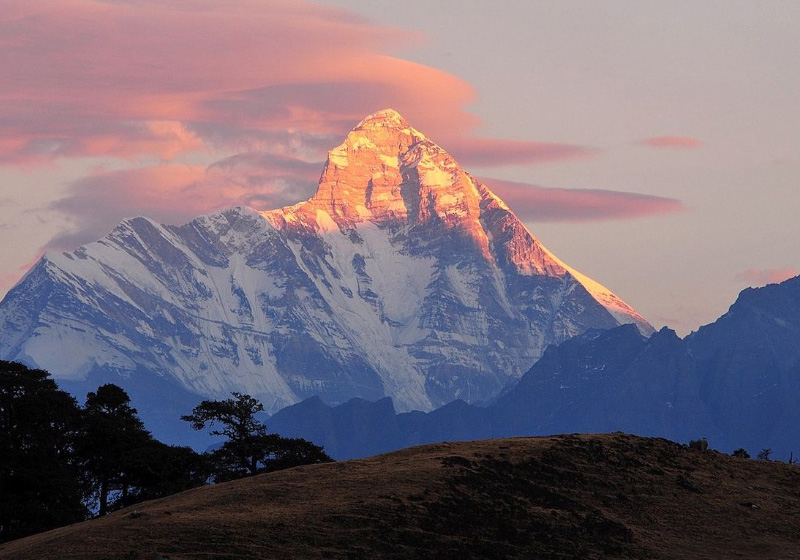
2. Nanda Devi (7,816 meters)
Nanda Devi is the highest mountain located entirely within India, and one of the most iconic peaks in the country. Situated in Uttarakhand’s Chamoli district, it forms the heart of the Nanda Devi Biosphere Reserve, a protected region recognized as a UNESCO World Heritage Site.
The mountain consists of two peaks:
Together, they create a natural fortress surrounded by high ridges, forming what is known as the Nanda Devi Sanctuary. This sanctuary is one of the most unique geographical formations in the Himalayas, acting as a natural enclosure that has preserved its ecosystem for centuries.
Due to its ecological sensitivity, the inner sanctuary has been closed to general tourism, which has helped maintain its pristine condition. This makes Nanda Devi one of the least disturbed high-altitude regions in India.
The area surrounding the mountain is known for:
Nearby, the Valley of Flowers National Park adds to the region’s appeal, offering a completely different experience with seasonal blooms and scenic trekking routes.
From a mountaineering perspective, Nanda Devi is considered a technically demanding climb due to:
Historically, it was one of the highest peaks ever climbed before Everest expeditions became common.
For travelers, while direct access to the core sanctuary is restricted, surrounding treks like Kuari Pass and Valley of Flowers provide a safe and scenic introduction to the region.
3. Kamet (7,756 meters)
Kamet is one of the highest peaks in the Garhwal Himalayas of Uttarakhand and stands close to the Tibetan plateau. It is the second-highest peak in this region after Nanda Devi and is known for its remote location and expedition-level difficulty.
Geographically, Kamet is part of the Zanskar range, surrounded by other significant peaks and glaciers. Its position north of the main Himalayan range makes it more exposed to extreme weather conditions, including strong winds and sudden temperature drops.
The mountain was one of the earliest high-altitude peaks to be successfully climbed (in 1931), which marked a significant milestone in Himalayan mountaineering history.
Key features of Kamet include:
Unlike popular trekking destinations, Kamet does not attract casual trekkers. It is primarily visited by professional mountaineers and expedition teams.
Challenges associated with Kamet:
The surrounding region, however, is visually striking, with vast snowfields and untouched landscapes that highlight the raw beauty of the Himalayas.
4. Saltoro Kangri (7,742 meters)
Saltoro Kangri is one of the highest peaks in the Karakoram Range, located near the Siachen Glacier in Ladakh. It is part of the Saltoro Mountains, a subrange known for its extreme altitude and rugged terrain.
This region is among the most remote and politically sensitive areas in the world, which significantly limits access for both tourism and mountaineering. As a result, Saltoro Kangri remains one of the least explored high peaks in India.
The mountain is characterized by:
The surrounding Karakoram region is often described as more rugged and dramatic than the Himalayas, with sharper peaks and deeper valleys.
Due to military presence and geopolitical factors, climbing expeditions are rare, and the area is largely inaccessible to civilians.
Despite this, Saltoro Kangri holds immense importance in:
It represents the extreme end of mountain exploration in India.
5. Saser Kangri (7,672 meters)
Saser Kangri is located in the Saser Muztagh subrange of the Karakoram, in Ladakh. It is one of the most significant peaks in this region due to its height and complex glacial surroundings.
The mountain lies near the historic Saser Pass, which was once part of ancient trade routes connecting India with Central Asia. This adds historical significance to its geographical importance.
Key characteristics of Saser Kangri:
Climbing Saser Kangri is considered extremely challenging because of:
Only a few successful expeditions have been recorded, making it a peak of interest primarily for experienced mountaineers.
The region remains largely untouched, offering a glimpse into some of the most isolated mountain landscapes in India.
From the towering peaks of the Himalayas to breathtaking scenic landscapes, experience the true beauty of India’s mountains. Let us plan your perfect adventure with customized itineraries and comfortable travel.
6. Mamostong Kangri (7,516 meters)
Mamostong Kangri is one of the highest mountain peaks in India, located in the Rimo Mustagh subrange of the Karakoram, close to the Siachen Glacier region. Standing at an elevation of 7,516 meters, it ranks among the tallest peaks not just in India but also globally.
What makes Mamostong Kangri particularly significant is its extreme remoteness and isolation. Unlike peaks in Uttarakhand or Himachal, this region lies deep within the Karakoram, far from regular trekking or tourist routes. The terrain here is dominated by vast glaciers, crevassed ice fields and high-altitude ridgelines that remain largely untouched.
The mountain is part of a complex glacial system connected to the Rimo Glacier, one of the important glacier networks feeding into the greater Karakoram system. This makes Mamostong Kangri not just a mountaineering objective but also a key geographical and glaciological feature.
Access to the region is highly restricted due to:
Because of these factors, Mamostong Kangri remains largely unexplored, with very limited documented expeditions. It is considered a peak for highly specialized mountaineers who can manage extreme conditions, long approach routes and logistical challenges.
Climbing challenges include:
This peak represents one of the last untouched frontiers of high-altitude exploration in India.
7. Abi Gamin (7,355 meters)
Abi Gamin is a prominent peak in the Garhwal Himalayas of Uttarakhand, located close to Kamet and Mana Pass near the India–Tibet border. With a height of 7,355 meters, it is one of the major peaks in this region and plays an important role in Himalayan mountaineering.
Compared to many other peaks above 7,000 meters, Abi Gamin is considered relatively more accessible, which is why it attracts experienced climbers looking for high-altitude expeditions without extreme technical complexity.
The mountain is characterized by:
Several climbing routes exist, including approaches via Meade’s Col and Mana Pass, making it a versatile peak for expedition planning. It is often climbed alongside Kamet as part of a combined expedition.
The surrounding environment is a classic high Himalayan setting:
Despite being comparatively accessible, Abi Gamin still requires:
For trekkers, the nearby regions such as Mana village and Badrinath area provide an entry point into this landscape, although the peak itself is reserved for serious climbers.
Abi Gamin stands out as a gateway peak for mountaineers aiming to progress towards more challenging Himalayan summits.
8. Hardeol (7,151 meters)
Hardeol, often referred to as the “Temple of God”, is located in the Kumaon region of Uttarakhand, near the Milam Valley. At 7,151 meters, it is one of the most visually striking peaks in this part of the Himalayas.
The mountain is known for its sharp ridges, steep faces and dramatic elevation, making it both a challenging climb and a visually dominant feature in the region. Its name reflects the spiritual connection often associated with Himalayan peaks, especially in remote areas where local traditions remain strong.
Hardeol is part of a cluster of peaks near the Nanda Devi Sanctuary, and the surrounding region is filled with glaciers, high-altitude valleys and untouched landscapes.
The Milam Glacier, located nearby, adds to the region’s importance. It is one of the largest glaciers in the Kumaon Himalayas and serves as a base for several trekking routes.
Climbing Hardeol is considered difficult due to:
Because of its isolation, the peak does not see frequent expeditions, which adds to its untouched character.
For travelers, while the summit itself is not accessible without mountaineering expertise, the Milam Valley trek offers one of the most rewarding high-altitude experiences in Uttarakhand. The route passes through traditional villages, river valleys and glacier viewpoints.
Hardeol represents a combination of natural beauty, spiritual significance and mountaineering challenge.
9. Trisul (7,120 meters)
Trisul is a group of three Himalayan peaks located in the Kumaon region of Uttarakhand, with Trisul I being the highest at 7,120 meters. The name “Trisul” is derived from the trident weapon of Lord Shiva, reflecting its deep cultural and mythological connection.
Historically, Trisul holds an important place in mountaineering. It was one of the first peaks above 7,000 meters to be successfully climbed (in 1907), marking a significant achievement in early Himalayan exploration.
The mountain is part of the Nanda Devi range and is surrounded by glaciers and high-altitude terrain. Its structure includes:
Compared to some other peaks in the Karakoram, Trisul is considered more accessible, which is why it has been a popular choice for mountaineering expeditions over the years.
However, it still presents challenges such as:
The region around Trisul is also important for trekking. Routes like the Roopkund trek and Kuari Pass trek offer distant views of the Trisul peaks, making it a familiar sight for many Himalayan trekkers.
Trisul combines historical importance, cultural symbolism and mountaineering appeal, making it one of the most well-known peaks in India.
10. Anamudi (2,695 meters)
Anamudi is the highest mountain peak in South India, located in Kerala within the Western Ghats. Although much lower in elevation compared to Himalayan peaks, it holds great importance due to its unique ecosystem and accessibility.
The name “Anamudi” translates to “Elephant’s Forehead”, referring to the shape of the peak. At 2,695 meters, it stands as the highest point in the Western Ghats and plays a crucial role in the region’s geography.
Unlike the harsh, icy landscapes of the Himalayas, Anamudi offers:
The peak lies within Eravikulam National Park, which is known for its conservation efforts and as a habitat for the endangered Nilgiri Tahr. The region is also home to a variety of flora and fauna unique to the Western Ghats.
One of the biggest advantages of Anamudi is its accessibility. While the summit itself requires permission, nearby trekking routes allow visitors to experience the terrain without technical climbing skills.
Key highlights of Anamudi include:
Anamudi provides a completely different mountain experience—one that is less about extreme altitude and more about nature, biodiversity and accessible exploration.
Step into the world of towering mountains, fresh alpine air, and breathtaking views. Whether you're seeking adventure or peaceful escapes, we’ll craft a journey that brings you closer to India’s most stunning high-altitude destinations.
The highest mountain peaks in India are not just about altitude. They play a crucial role in:
They also represent some of the most challenging terrains on Earth, attracting explorers and mountaineers from across the globe.
If you are planning to explore regions near these peaks, keep the following in mind:
For general travelers, trekking routes around these peaks offer a safer way to experience their beauty.
India’s highest mountain peaks represent a world that is both powerful and fragile. From the towering Kanchenjunga to the serene landscapes of Anamudi, these mountains offer a wide range of experiences.
Whether you are interested in trekking, photography or simply understanding the geography of India, these peaks provide endless opportunities for exploration.
Fill in the details below. Our expert consultant will respond within 4 hours with a bespoke itinerary crafted just for you — completely free, no obligation.