Itinerary ideas, cultural insights, luxury tips and practical planning guides for every India traveller.
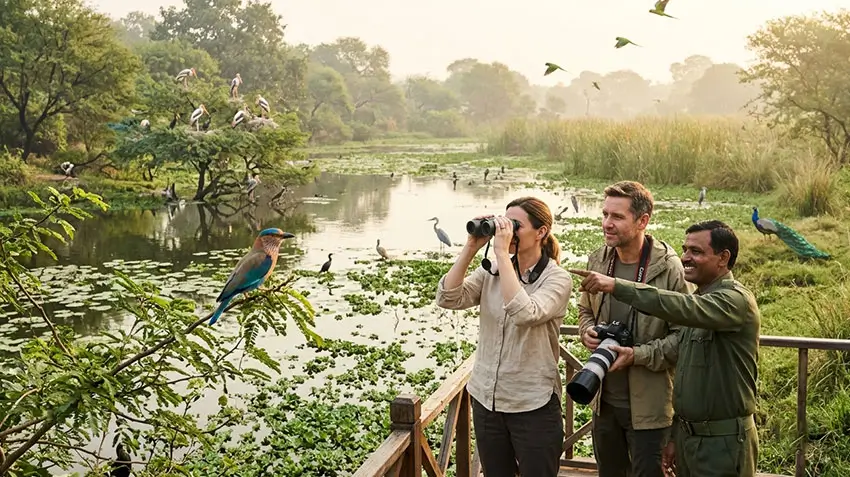
India offers an unusually wide range of birding environments within a single country. Wetlands, dry forests, grasslands, desert habitats, Himalayan foothills, river systems and national parks can produce completely different sightings within the same private journey. For a serious birder, however, simply visiting a wildlife destination is not enough. The quality of the trip depends heavily on the guide, timing, habitat selection, transport and the amount of uninterrupted time available in the field.
A private India birdwatching tour package should therefore operate differently from a conventional sightseeing holiday. Bird activity often begins early. A productive morning may require leaving the lodge before breakfast, carrying packed food and spending several hours at a wetland or forest edge. The afternoon may involve a second birding session rather than visiting a city monument. The vehicle needs enough room for binoculars, cameras, scopes and luggage, while accommodation should be selected partly for its proximity to the birding area.
India's bird diversity also makes the country suitable for different levels of interest. A first-time wildlife traveller may simply want to see kingfishers, hornbills, raptors, storks, owls and colourful resident species. An experienced birder may arrive with a target list and want to spend considerable time searching for a particular species. A wildlife photographer may care less about total species count and more about light, distance, background and the opportunity to remain quietly in one location.
For that reason, a good private birding tour in India should begin with the traveller's priorities rather than a generic wildlife itinerary.
Destinations such as Keoladeo National Park at Bharatpur can work particularly well for travellers combining birding with Delhi, Agra or Rajasthan. Other regions can be added when the trip is specifically centred on birds and wildlife. The strongest itinerary is not necessarily the one containing the largest number of national parks. It is the one that provides sufficient field time in the habitats most relevant to the traveller.
A general sightseeing guide and a specialist birding guide perform very different jobs.
A city guide may be excellent at explaining architecture, history and local culture but may not be able to identify a distant raptor, separate similar warbler species or recognise a bird from a brief call. A private birding guide in India should have practical knowledge of local habitats, seasonal movements, bird calls, likely feeding areas and the field characteristics used to distinguish similar species.
For keen birders, this specialist knowledge can be the most valuable part of the package.
A bird may appear for only a few seconds. The guide needs to identify movement quickly, communicate its position clearly and help the guest find it through binoculars. Directions such as “left of the dead branch” or “two o'clock from the tall tree” become part of the day's working language.
The guide should also understand that different clients have different goals.
A beginner may want identification help and enough time to observe common species properly. A traveller keeping a life list may want accurate species identification and notes. A photographer may be willing to wait forty minutes for a bird to move into better light.
This information should be communicated before the tour begins.
For a bird photography tour in India, ask whether the guide regularly works with photographers. Photography-oriented birding can require a different pace. A birder may be satisfied after identifying a species clearly through binoculars, whereas a photographer may need a clean angle, suitable light and enough distance to avoid disturbing the bird.
A responsible guide should never guarantee a wild bird sighting.
Birds move according to habitat, weather, food availability, disturbance and numerous natural factors. Even a species regularly recorded in an area can be absent on a particular morning. Claims such as “100% guaranteed sighting” should therefore be treated cautiously when dealing with genuinely wild species.
Instead, ask about realistic possibilities and the habitats being visited.
A target list can be extremely useful. Travellers can send a list of priority species before arrival, allowing the birding team to assess which locations fit those interests. A list also prevents valuable field time from being spent repeatedly looking at species the guest has already seen many times unless they specifically want photographs.
Birding schedules frequently begin around sunrise because morning activity can be productive. Exact departure time changes according to location and season. Rather than publishing one fixed time for every destination, the guide should set the next morning's departure according to local sunrise, access rules and current field conditions.
This is one reason private arrangements are valuable.
On a conventional group holiday, breakfast may be served at 8:00 AM and sightseeing may start at 9:00 AM. On a specialist birdwatching holiday in India, the group may already have spent several hours in the field by then.
Hotels or wildlife lodges can provide packed breakfast where available. After the morning session, guests can return for lunch and rest before an afternoon outing.
A birding guide can also help determine when staying in one location is better than continually moving. Birdwatching often rewards patience. Driving an additional 100 kilometres merely to add another destination can be less productive than spending a second morning in a rich habitat.
Private birding also gives the traveller control over observation time. If an interesting mixed flock is active, there is no need to leave merely because a conventional sightseeing schedule says the next attraction starts in ten minutes.
Ethical field behaviour is essential.
Bird calls and playback should never be used carelessly. Repeated playback can disturb birds, particularly around breeding territories. Nests should not be approached simply to obtain a photograph. Vegetation should not be damaged to create an unobstructed image.
A reputable India birding guide service should place the welfare of the bird above the photograph.
This approach also produces a better experience. Watching natural behaviour—feeding, hunting, displaying or interacting with other birds—is far more rewarding than repeatedly forcing a stressed bird to react to artificial sound.
From Bharatpur Bird Sanctuary to the wetlands of Rajasthan and the beautiful birding destinations across India, enjoy a memorable wildlife experience. Our private tours offer expert guidance, comfortable travel and personalized itineraries for birdwatchers and nature lovers.
For travellers already visiting North India, Bharatpur is one of the most practical additions to a birding itinerary. Keoladeo National Park is internationally known as an important wetland bird habitat and is located conveniently between the Agra and Jaipur side of many North Indian road journeys.
The park can support resident and migratory birds depending on season and conditions. Visitors may encounter waterbirds, raptors, kingfishers, woodpeckers, owls and numerous smaller species, although no particular sighting should be guaranteed.
A Bharatpur birdwatching tour deserves more than a rushed roadside stop.
A serious birder can spend a full morning in the park and still have reason to return in the afternoon or the following morning. Bird activity, light and species distribution can change throughout the day.
Entry rules, current fees, opening arrangements and guide or cycle-rickshaw charges can change, so these should be confirmed against current official information immediately before the visit rather than relying on an old printed rate.
For travellers with only a moderate interest in birds, one morning may be sufficient. For birders and photographers, two sessions or a two-night stay can be far more rewarding.
Ranthambore is primarily associated with tiger safaris, but the wider landscape also supports considerable birdlife. A wildlife traveller can combine mammal-focused safari drives with bird observation around suitable habitats. The experience is different from Bharatpur because access, safari vehicles and national park rules determine how guests move through core tourism zones.
A birding and wildlife tour in India can therefore combine different habitat types rather than treating every destination as the same kind of birdwatching.
For specialist itineraries, Himalayan foothill regions can add another layer of diversity. Forest elevations and mountain habitats support species that will not normally be encountered in the plains. Such trips require more travel time and should not be inserted casually into a short Delhi–Agra–Jaipur holiday.
Likewise, desert and semi-arid areas of Rajasthan can produce a completely different field experience from wetlands. Grassland and desert specialists require habitat-specific visits, and some sensitive species may face conservation pressures that make responsible guiding especially important.
A private itinerary should be designed around geography.
Travellers should avoid creating a birding trip where every second day consists of a long transfer. Early mornings followed by five- or six-hour drives can quickly become tiring, particularly when carrying heavy camera equipment.
A practical birding day may begin before or around sunrise with tea or coffee at the lodge. The group then reaches the birding location as early as access permits. The first field session may continue for several hours, followed by breakfast or brunch.
Midday can be used for rest, downloading photographs, charging batteries and reviewing sightings.
An afternoon session can begin when conditions become more comfortable and bird activity increases again. The group then returns to the lodge around or after sunset, depending on local rules.
This rhythm is very different from standard tourism, which is why a custom birdwatching tour of India should not simply be a conventional sightseeing itinerary with one bird sanctuary added.
Night birding is another specialist activity, but it should only occur where access is legally permitted and where disturbance can be kept to an appropriate level. Protected areas have their own entry rules and closing times. Guests and guides should respect them.
Birding outside protected areas also requires responsible behaviour. Agricultural land, village ponds and forest edges may contain excellent birdlife, but not every location is public property. Local access and privacy should be respected.
Weather can alter the day significantly. Fog may affect winter mornings in North India. Heat can reduce comfortable field time during warmer periods. Rain can alter road conditions and bird activity.
The guide should be able to adjust the schedule rather than blindly following a printed itinerary.
Transport for birding needs to do more than move passengers between hotels.
A birder may carry binoculars, a spotting scope, tripod, field guide and day bag. A photographer may travel with multiple camera bodies, long lenses, monopods, chargers, laptop equipment and hard cases. When this is added to normal international luggage, vehicle space becomes important.
For one or two travellers, a sedan can technically handle many road transfers, but a larger SUV or MPV is often more practical for a private bird photography tour in India.
An Innova-type vehicle provides more cabin and luggage room, easier access to equipment and better comfort on long intercity sectors. A premium vehicle does not improve the birds, but it can make a major difference after a four- or five-hour drive.
Photographers should state the number and approximate size of equipment cases before the vehicle is assigned.
A car full of suitcases leaves little room for safely storing expensive photographic equipment. Camera bags should never need to travel unsecured on the roof simply because the vehicle was chosen according to passenger count alone.
The driver is another important part of the trip.
A driver experienced with wildlife clients learns that stopping safely for a roadside sighting may be useful when legally possible. The driver also understands that a 100-kilometre journey can take longer when guests repeatedly stop for birds.
However, birding should never encourage unsafe roadside behaviour. Vehicles should only stop where it is safe and lawful, and travellers should not step into traffic for a photograph.
A chauffeur-driven birding tour in India can keep the same driver for multiple road-connected destinations. This reduces repeated luggage handling and gives the driver familiarity with the group's equipment and routine.
Accommodation should be selected according to location as well as star rating.
A luxury city hotel may have excellent rooms but be an hour from the birding site. A comfortable wildlife lodge fifteen minutes away can provide much more field time.
For serious birders, proximity can be worth more than marble bathrooms.
A good wildlife lodge for birdwatchers in India should ideally provide early tea or coffee, packed breakfast where available, flexible meal arrangements, reliable electricity for charging equipment and enough room to organise camera gear.
Wi-Fi may matter to photographers who back up images online, although connectivity can be inconsistent in remote areas. Carrying sufficient memory cards and independent backup storage is sensible.
Electricity requirements should also be considered. International travellers may require appropriate plug adapters. Multiple camera batteries, phone batteries and laptops can create competition for limited room sockets, so a compact charging arrangement can be useful.
Photographers should not leave high-value equipment unattended in a vehicle. Normal travel precautions remain important even when travelling with a private driver.
Laundry service becomes useful on longer wildlife trips because early field sessions and dusty conditions can quickly affect clothing.
Clothing should generally be comfortable and suitable for the environment. Neutral, non-disruptive clothing can be preferable in wildlife areas. Footwear should match the expected terrain, and layers can be valuable during cold early mornings followed by warmer afternoons.
Binoculars are highly recommended even for photographers. A long camera lens is not always the easiest way to locate a moving bird.
A spotting scope can be extremely useful in wetlands and open habitats. Travellers should ask whether the specialist guide provides one or whether they should bring their own.
Explore India's incredible birdlife with customized birdwatching tour packages. Visit famous bird sanctuaries, national parks and wetlands with experienced local guides, comfortable private transportation and flexible itineraries. Plan your unforgettable birdwatching holiday in India with us.
The cost of an India birdwatching tour package can vary more than a standard sightseeing holiday because specialist guides, wildlife accommodation, park access and private transport can form a substantial part of the total.
A traveller seeking comfortable mid-range accommodation, a private car and specialist guiding should allow a higher budget than a basic city tour.
For a private trip for two people, a broad ground budget can begin around ₹15,000–₹25,000 per day for the travelling party when using comfortable accommodation and private road transport, depending heavily on destination and guide arrangements.
A stronger wildlife setup with better lodges, specialist birding services and a premium vehicle can commonly move towards ₹25,000–₹45,000+ per day for two travellers.
High-end wildlife lodges, premium rooms, dedicated specialist guides, multiple safari drives and complex regional routing can push the cost beyond ₹50,000 per day, sometimes substantially higher.
These are practical budgeting bands rather than fixed quotations.
A dedicated private birding guide fee in India can vary according to destination, expertise, language, duration and whether the guide travels with the guests between regions. Local specialist guides and accompanying tour leaders are different services and can be priced differently.
Travellers should ask whether guide accommodation and meals are already included when a specialist travels with them.
Protected-area costs also vary. Entry fees, camera fees where applicable, safari vehicle charges, naturalist fees and other official charges depend on the destination and current regulations.
These should be checked for the actual travel dates.
A birding quotation should clearly identify whether it includes wildlife lodge accommodation, breakfast, other meals, private vehicle, driver expenses, tolls, parking, specialist bird guide, protected-area entry and safari bookings.
International flights, travel insurance, personal equipment, alcoholic beverages, tips and personal expenses are commonly separate unless stated otherwise.
Photographers should mention professional or unusually extensive equipment if a protected area has special rules or fees associated with certain equipment. Regulations can change and should be verified before arrival.
The booking request should include the traveller's birding level.
“Interested in wildlife” is not the same requirement as “experienced birder with 25 target species.” The more precise the request, the better the guide and itinerary can be matched.
A useful enquiry should state travel dates, number of guests, preferred accommodation level, destinations already being considered, photography interest, target species if any and whether the traveller wants birding every day or only on selected mornings.
This also prevents overbooking the itinerary.
Someone visiting India for the first time may want a combination of birds, major cultural sites and comfortable hotels. Another traveller may happily spend three consecutive mornings at the same wetland. Both are valid trips, but they should not receive the same itinerary.
For wildlife photography, vehicle and safari positioning rules must be respected. Paying for a private service does not provide permission to leave designated tracks, approach wildlife illegally or ignore park instructions.
A reputable operator should never promise such access.
A strong private birdwatching holiday in India provides something more valuable: time, local field knowledge, appropriate logistics and the ability to concentrate on birds without constantly organising cars, guides and accommodation.
The traveller wakes early, meets a specialist who knows the habitat, reaches the field at the right time, returns to accommodation suited to wildlife travellers and has a vehicle capable of carrying both luggage and optical equipment.
For birders, that practical structure can matter far more than adding another city to the route.
A private package can include accommodation, private car and driver, specialist birding guides, selected meals, airport transfers and birding excursions. Protected-area tickets, safari costs and specialist activities may be included or charged separately. The quotation should identify every major inclusion.
Keoladeo National Park at Bharatpur is one of North India's best-known birding locations and can fit conveniently into a road journey involving Agra and Rajasthan. The quality and variety of sightings vary with habitat conditions, season and natural bird movements.
Casual wildlife visitors may be satisfied with one extended session, while serious birders and photographers can benefit from two or more field sessions. A two-night stay allows both morning and afternoon opportunities without making the visit excessively rushed.
A specialist birdwatching guide is particularly valuable for identifying calls, locating less obvious species and distinguishing similar birds. General wildlife enthusiasts can also benefit because a specialist can explain habitat and behaviour rather than merely pointing out birds.
No responsible birding operator should guarantee a wild species. Guides can select appropriate habitat and use recent local knowledge, but weather, migration, food availability and natural movement affect sightings.
For one or two photographers carrying long lenses and several equipment bags, an Innova-type MPV can be more practical than a small sedan. Larger groups may need a Tempo Traveller or another suitable vehicle with enough protected luggage space.
Yes. Bharatpur's location makes it particularly convenient for travellers combining birdwatching with Agra and Rajasthan. A private itinerary can include cultural sightseeing and dedicated birding sessions without requiring every day to focus exclusively on wildlife.
A comfortable private trip for two can broadly start around ₹15,000–₹25,000 per day for the travelling party. Better wildlife lodges, premium vehicles, specialist guides and safari activities can raise costs to ₹25,000–₹50,000 or more per day.
A scope is especially useful in wetlands and open habitats, although many specialist guides may have access to one. Photographers should confirm available equipment before departure rather than assuming binoculars, scopes or tripods will be provided.
Provide travel dates, number of guests, accommodation preference, birding experience, photography requirements, approximate equipment quantity and any target species. Also state whether the trip should be primarily bird-focused or combine private birding tours with cultural sightseeing.
Fill in the details below. Our expert consultant will respond within 4 hours with a bespoke itinerary crafted just for you — completely free, no obligation.