Itinerary ideas, cultural insights, luxury tips and practical planning guides for every India traveller.
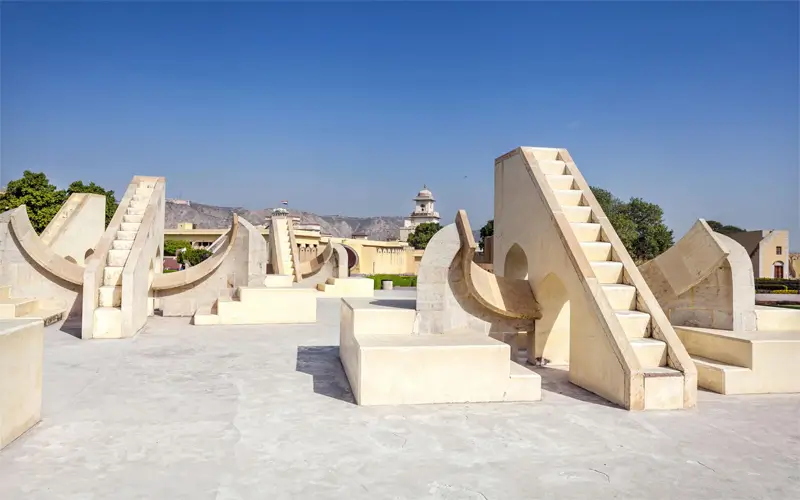
Located beside the magnificent City Palace in the heart of Jaipur, Jantar Mantar is one of the city's most remarkable historical attractions. At first glance, the enormous stone structures may appear unusual, but each one was carefully designed to measure time, track celestial movements, predict eclipses, and observe astronomical events with remarkable accuracy long before modern technology existed.
Built in the early eighteenth century by Maharaja Sawai Jai Singh II, the observatory continues to impress visitors with its scientific precision and architectural brilliance. Unlike a traditional museum where instruments are displayed inside glass cases, Jantar Mantar itself is the observatory. Every staircase, curved wall, arch, and circular structure was created for a specific astronomical purpose.
For travelers visiting Jaipur as part of a Golden Triangle Tour, Jantar Mantar is one of the easiest attractions to include in a full-day sightseeing schedule because it stands within walking distance of City Palace, Hawa Mahal, and several popular markets. Most visitors spend one to two hours exploring the observatory while learning how astronomy played an important role in royal administration during the Mughal and Rajput periods.
Its combination of science, history, architecture, and cultural significance earned Jantar Mantar recognition as a UNESCO World Heritage Site, making it one of India's most important scientific heritage monuments.
The monument is managed by the Rajasthan Government, and tickets are available at the entrance as well as through selected online booking platforms.
The expected ticket prices for 2026 are:
| Visitor Category | Expected Entry Fee |
| Indian Citizens | ₹50 per person |
| Foreign Tourists | ₹200 per person |
| Students (with valid ID) | Concessional rates may apply |
| Children | As per current government policy |
Combined tickets covering nearby monuments may also be available during certain periods.
Digital payment, UPI, debit cards, credit cards, and cash are generally accepted at the ticket counter.
The observatory remains open every day.
Opening Time: 9:00 AM
Closing Time: 5:00 PM
Visitors should ideally arrive before 3:30 PM to comfortably explore all the astronomical instruments without rushing.
Morning visits are especially pleasant during summer, while winter afternoons provide comfortable temperatures for walking around the open observatory.
Jantar Mantar was constructed between 1728 and 1734 by Maharaja Sawai Jai Singh II, the founder of Jaipur. Apart from being a successful ruler, Jai Singh was deeply interested in astronomy and mathematics. He believed that the existing astronomical tables used across India required greater accuracy, prompting him to commission a series of observatories in different cities.
Five observatories were built in Delhi, Jaipur, Ujjain, Mathura, and Varanasi. Among them, the Jaipur observatory remains the largest and the best preserved.
Rather than relying on small metal instruments, Jai Singh designed massive masonry structures that reduced observational errors and improved measurement accuracy. These giant instruments allowed astronomers to determine local time, study planetary positions, calculate eclipses, and observe the movement of stars with impressive precision.
Even today, several instruments continue to produce remarkably accurate readings when properly operated, demonstrating the advanced scientific knowledge available in India during the eighteenth century.
Discover the remarkable astronomical instruments of Jantar Mantar and explore the royal heritage of Jaipur with a customised sightseeing tour.
UNESCO recognised Jantar Mantar Jaipur because of its outstanding contribution to the history of astronomy and science.
The observatory contains the world's largest collection of monumental astronomical instruments built from stone and marble. Unlike mechanical observatories that relied on moving metal equipment, these fixed structures were carefully aligned with celestial coordinates to perform highly accurate observations.
The site represents a rare combination of architecture, mathematics, engineering, astronomy, and royal patronage. It also reflects the exchange of scientific knowledge between India, Persia, Central Asia, and Europe during the eighteenth century.
Because of its excellent preservation and historical significance, Jantar Mantar remains one of the world's most important astronomical heritage sites.
The observatory contains nineteen major astronomical instruments, each serving a unique purpose.
Samrat Yantra
The Samrat Yantra is the largest and most famous instrument inside the observatory. Standing approximately 27 metres high, it functions as an enormous sundial capable of measuring local solar time with impressive accuracy under suitable conditions.
Its massive triangular structure dominates the complex and attracts almost every visitor entering the observatory.
Jai Prakash Yantra
This fascinating instrument consists of bowl-shaped structures with carefully marked celestial coordinates. Astronomers used it to determine the position of stars and planets by observing their shadows.
Visitors often find this instrument particularly interesting because its design differs greatly from conventional scientific equipment.
Ram Yantra
The Ram Yantra measures the altitude and direction of celestial bodies. Two identical circular structures work together to provide highly accurate observations.
The open design also makes it one of the most photogenic areas inside Jantar Mantar.
Rashivalaya Yantra
This group of instruments was designed specifically to observe different zodiac constellations throughout the year. Each instrument corresponds to a particular zodiac sign and was used to improve astronomical calculations.
The ideal months for visiting Jantar Mantar are October to March, when Jaipur experiences pleasant weather.
Summer temperatures can exceed 40°C, making afternoon visits uncomfortable because the observatory offers limited shade.
Morning visits during summer are strongly recommended.
During the monsoon season, occasional rainfall cools the surroundings, although slippery pathways may require extra caution.
Make Jantar Mantar part of your Pink City itinerary.
Jantar Mantar offers outstanding photography opportunities because of its unusual geometric structures and open spaces.
Some useful tips include:
Jantar Mantar is centrally located in Jaipur's historic Pink City.
By Taxi
Approximate taxi fares:
Travel time varies depending on city traffic.
By Auto-Rickshaw
Auto-rickshaws are widely available throughout Jaipur and provide an economical transport option for short distances.
By Public Bus
Several city buses stop near the Pink City area, followed by a short walk to the entrance.
Many travelers combine Jantar Mantar with nearby attractions because they are located within walking distance.
Popular places include:
These attractions can comfortably be covered in a single sightseeing day.
Wear comfortable footwear because much of the observatory is explored on foot over stone pathways. Since the site is completely open to the sky, carrying sunglasses, sunscreen, and drinking water is recommended, especially during warmer months.
Hiring an authorised guide can greatly improve the visit because many astronomical instruments appear confusing without explanation. Visitors interested in science, architecture, or history should allow at least one and a half to two hours to fully appreciate the observatory.
Weekdays generally provide a quieter experience than weekends, making it easier to photograph the instruments without large crowds.
The observatory is generally open daily from 9:00 AM to 5:00 PM.
The expected ticket price is ₹50 per person.
Foreign visitors can expect an entry fee of around ₹200 per person.
It houses the world's largest collection of monumental astronomical instruments built from stone.
Most visitors spend 1.5 to 2 hours exploring the observatory.
Yes. UNESCO recognised it for its scientific and cultural significance.
The Samrat Yantra is the largest stone sundial in the observatory.
Yes, photography is permitted in most public areas.
Yes. They are located next to each other and are commonly visited on the same day.
October to March offers the most comfortable weather.
Yes. Understanding the astronomical instruments becomes much easier with a licensed guide.
Yes, tickets may be booked through authorised government ticketing platforms and selected tourism websites.
Fill in the details below. Our expert consultant will respond within 4 hours with a bespoke itinerary crafted just for you — completely free, no obligation.